Plate
Plate refers to both the act of arranging food on a serving dish (verb) and the prepared dish itself ready for service (noun). In professional kitchens, plating is the final step in food preparation where components are assembled and presented before reaching the guest.
In restaurant kitchens, ‘plate’ functions as both a verb and a noun with distinct meanings. As a verb, ‘to plate’ means arranging and presenting food on a serving dish in a visually appealing manner—the final step before a dish reaches the guest. As a noun in kitchen slang, ‘plate’ refers to a prepared dish ready for service, as in “I need two salmon plates on the fly.”
The Pass: Where Plating Happens
Plating occurs at ‘the pass’ (also called ‘the window’)—the critical handoff point between kitchen and dining room. This station is where finished dishes are assembled, checked for quality, and held briefly before servers pick them up. The expeditor (expo) manages this area, calling out orders, coordinating timing across stations, and ensuring each plate meets presentation standards before it leaves the kitchen.
When a dish is ready, kitchen staff call out “Hands!” to signal servers or food runners to pick up the plate. This verbal cue keeps service flowing efficiently during busy shifts. Conversely, a ‘dead plate’ is food that has sat too long under heat lamps or on the pass—it’s lost temperature, appearance has degraded, and it must be remade rather than served.
Traditional Plating Guidelines
Professional kitchens use the clock face method as a plating guide. Protein is typically positioned at 4-8 o’clock, starch at 9-10 o’clock, and vegetables at 2-3 o’clock. The ‘6 o’clock plate position’ refers to the edge of the plate placed closest to the guest when the server sets it down—this orientation ensures the main component faces the diner.
This layout isn’t arbitrary. It creates visual balance, makes the dish look intentional rather than random, and ensures consistency across multiple orders of the same dish. Line cooks learn this system early because it allows them to plate quickly while maintaining standards during high-volume service.
Modern Plating Techniques and Tools
Contemporary kitchens employ four main plating styles: classic (traditional clock method), free-form (asymmetrical and artistic), deconstructed (components separated intentionally), and minimalist (sparse presentation with negative space). The style chosen reflects the restaurant’s concept and price point—fine dining typically leans toward artistic or minimalist approaches, while casual concepts favor classic plating for speed and consistency.
Professional plating requires specialized tools beyond basic kitchen equipment. Precision tongs allow precise placement of delicate garnishes. Squeeze bottles create sauce dots, lines, and artistic designs. Offset spatulas spread purées and move components without disturbing other elements. Ramekins hold sauces or sides that complement the main plate. Plating wedges help position food at angles, and ring molds create uniform shapes for composed dishes.
Plating in High-Volume Operations
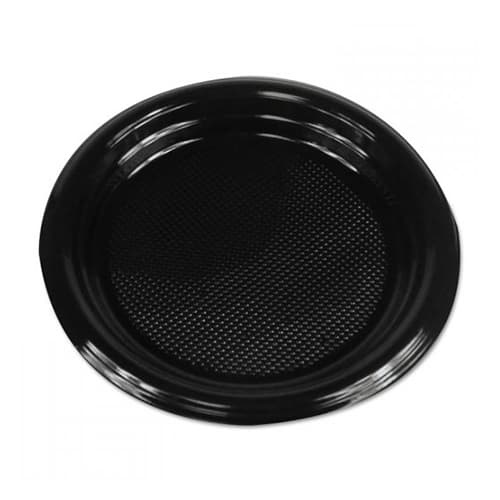
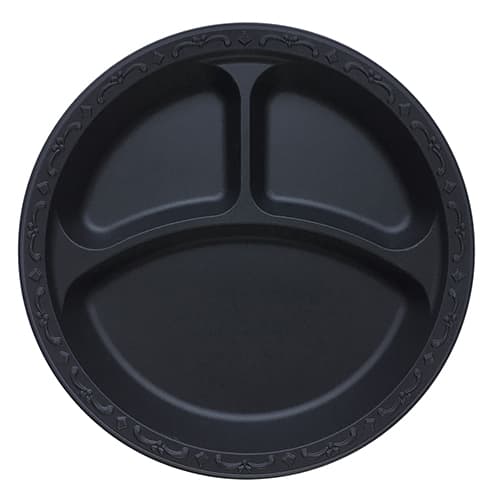
Fast-casual and catering operations adapt plating principles to disposable plastic plates and catering supplies. The fundamentals remain—visual balance, portion control, and appealing presentation—but execution focuses on speed and practicality. Even takeout operations benefit from thoughtful plating since customers photograph their food before eating, making presentation a marketing tool.
When selecting disposable dinnerware, consider plate size relative to portion size (food should cover 60-70% of the plate surface), depth for sauced items, and color (white and black are most versatile for highlighting food). Tabletop and guest presentation choices directly impact perceived value, regardless of whether you’re using china or disposables.
Common Uses
The term 'plate' is used constantly in professional kitchens during service. Chefs say "plate this order" to direct line cooks to begin final assembly. Expos call out "I need two lamb plates" when coordinating orders. Servers respond to "Hands!" to pick up finished plates from the pass. The verb form appears in prep instructions: "Plate the desserts before service and hold them in the cooler." Kitchen managers discuss plating standards during training: "Every salmon plate should look identical." The dual meaning creates no confusion in context—"Can you plate three salads?" clearly means prepare them, while "three salad plates are dying in the window" means finished dishes are waiting too long.