
Packaging that survives the trip, not just the photo
Compostable trays, bowls and boxes built for food that is cooked once, chilled, shipped and reheated by someone else. Sealable, freezer safe and available without a minimum order.
- No minimum order
- Free member shipping
- Film and lid sealable
- Freezer to microwave
- PFAS free
What packaging do ready meals and meal kits actually need?
Three things a normal takeout container does not have to do: take a seal that survives a courier, go from a chiller or freezer into a microwave without warping, and still look deliberate when it reaches a kitchen table two days later. Worth knowing before you over-correct on packaging: a University of Michigan life-cycle study found meal kits produce 6.1 kg CO₂e per meal against 8.1 kg for the same meal bought at a grocery store, a third less, because pre-portioning cuts food waste by more than the extra packaging costs. The packaging decision is about whether the food arrives intact.
- Sealed meals: a fiber or PP tray with a film seal, because a snap lid will not hold through a van
- Meal kits: a kraft mailer with portioned bags inside, so ingredients stay separate and dry
- Cloud kitchens: vented lids and a leak-resistant base, because the food goes out hot
- Meal prep: stackable, reheatable, and cheap enough to hand over five at a time
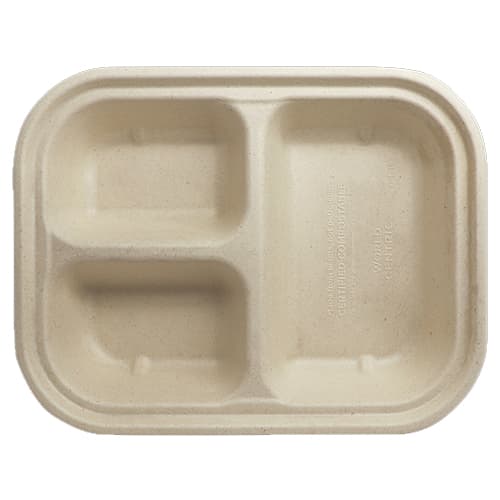
Cooked, chilled and sold to be reheated. The tray has to take a film seal, survive a chiller, and go into a microwave without warping or leaching. Fiber works for most menus; polypropylene is the answer when the food is wet, oily or reheated repeatedly.
- Seal
- Film or snap lid
- Temp range
- 0 to 220 °F
- Freezer
- Yes
- Compartments
- 1 to 3
Choosing the material, in one pass
Most operators leaving foam start with molded fiber, because it handles heat, stacks well and composts commercially. It has one real weakness: sustained contact with oil or sauce. A PLA liner fixes that while staying compostable, at roughly five cents more a unit.
If the food is cold and the point is that people can see it, PET is the right answer and it recycles curbside in most of the country. If the meal is reheated several times across a week, polypropylene outlasts both and is the honest choice even though it is not compostable. Pretending otherwise gets you returns.
Two things to check before a pallet order, whichever you pick. The max temp rating, because a tray that warps at 200 °F will warp in a customer's microwave. And whether the lid you want is actually sealable with the machine you already own, since film seal and snap lid are not interchangeable.
Carbon per 1,000 meals packed
What your volume actually costs
- 208,000
- meals a year
- $128,960
- packaging spend
- 1,706
- lbs CO₂ avoided
- $1,560
- GreenBux credit
Assumes a tray, lid and sleeve at member pricing. Carbon is the difference against foam at the same volume. GreenBux accrue on every order and redeem as store credit at the current rate.
The part that goes wrong is the cold chain
Packaging failures in meal delivery are almost never the container. They are the hours between your chiller and someone's doorstep, and they are solvable with three decisions.
up to 48 hrs
Insulated liners
Recycled denim and fiber liners hold a chilled box in range for a two-day courier window without foam. They flat-pack, so they do not eat your storage.
2 sizes
Gel packs and dry ice
Gel for chilled, dry ice for frozen. The common mistake is one size for both, which either melts early or freezes the food you meant to chill.
tamper evident
Seals that show
A courier-proof seal is also a trust signal. Tamper-evident lids and film reduce the refund conversation more than any amount of branding does.
1 to 4 colors
Custom print
Print the box in our Design Studio, see a proof before you pay, and keep the plate count down. Colour identity is free; colour count is what costs.
no minimum
Test before you commit
Order one case of three candidates and run them through your real route. Nothing on a spec sheet tells you how a lid behaves in a hot car.
same week
Samples
Sample requests go out the same week and the first set is free, which is faster than most suppliers will quote you.
- 1,900+
- products in stock
- 33%
- lower emissions per meal
- 28.1%
- of US municipal waste is packaging
- $0
- member shipping
No minimum on any of them
Meal kits vs the same meal from a grocery store, farm to landfill
Heard et al., Resources, Conservation and Recycling (University of Michigan) (2019)
82.2 million tons generated, 53.9% of it recycled
US EPA, Containers and Packaging: Product-Specific Data (2018)
At any order size
Questions we get from meal services
Sources
Every figure on this page traces to one of these. Each was opened and read, not taken from a search summary.
- Heard et al., Resources, Conservation and Recycling (University of Michigan) · data year 2019
- US EPA, Containers and Packaging: Product-Specific Data · data year 2018
Test three options on your real route
Order one case of each, run them through the trip your food actually takes, and keep the one that arrives intact. Samples go out the same week and the first set is free.