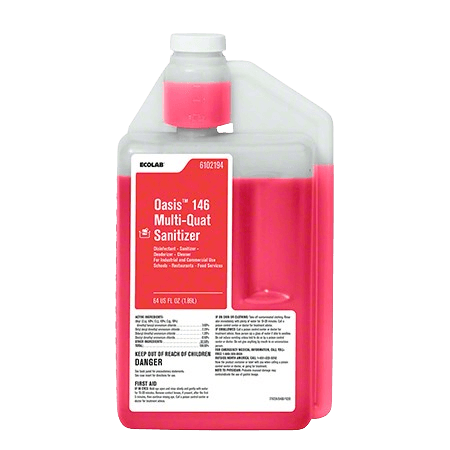
Quaternary Ammonium
Quaternary ammonium compounds (quats or QACs) are chemical disinfectants and sanitizers approved for use on food contact surfaces in foodservice operations, effective against bacteria, fungi, and some viruses at standard concentrations of 200 parts per million.
Quaternary ammonium compounds (commonly called quats or QACs) are chemical disinfectants and sanitizers approved by the EPA and FDA for use on food contact surfaces in restaurants, commercial kitchens, and foodservice operations. They’re one of three primary chemical sanitizers approved for foodservice—alongside chlorine and iodine—and are valued for their broad-spectrum antimicrobial activity against bacteria, fungi, and some viruses.
How Quaternary Ammonium Sanitizers Work
Quats are cationic (positively charged) compounds that disrupt bacterial cell membranes to kill microorganisms. The standard concentration for sanitizing food contact surfaces is 200 parts per million (ppm), though approved ranges typically span 150-400 ppm depending on manufacturer instructions and local health codes. Unlike chlorine sanitizers, quats leave a residue that continues providing antibacterial protection after surfaces dry, and they don’t require rinsing when used at approved concentrations.
Contact time matters: sanitized surfaces must remain visibly wet for at least one minute before air drying. This wet contact time allows the quaternary ammonium compounds to effectively kill microorganisms on the surface.
Common Restaurant Applications
Quats work on hard, non-porous surfaces including stainless steel equipment, cutting boards, utensils, glassware, dishes, and food processing equipment. In the three-compartment sink, quats are the sanitizer of choice in the third basin. They’re also used in spray bottles for sanitizing prep surfaces, conveyor belts, and high-touch areas throughout the kitchen.
Commercial quat sanitizers often come as tablets (brands like Steramine) that dissolve in water to create ready-to-use sanitizing solutions. Porous surfaces like untreated wood may absorb the sanitizer, reducing effectiveness and requiring different application methods or higher concentrations.
Testing and Compliance Requirements
Federal, state, and local health regulations require test strips to verify proper quat concentration. QAC test strips measure 0-400 ppm or 0-500 ppm ranges—dip the strip for one second, then compare the color change to the chart on the test strip vial. Health inspectors routinely check that kitchens are testing their sanitizer solutions and maintaining proper concentrations.
All quaternary ammonium sanitizers must be EPA-registered and approved for food contact surface use. The FDA regulates their use under 40 CFR § 180.940(a)(c), and USDA approves specific products for federally inspected meat and poultry plants.
Advantages Over Other Sanitizers
Quats offer several practical benefits in busy kitchens. They’re less corrosive to metal surfaces than chlorine, making them safer for stainless steel equipment and metal utensils. They work effectively on both metal and wood surfaces, remain stable in hard water, and aren’t as affected by organic soil as chlorine sanitizers. The residual antibacterial effect after drying provides ongoing protection between sanitation cycles.
The no-rinse requirement at approved concentrations speeds up dish washing and surface sanitizing workflows, and quats don’t have the strong odor associated with chlorine-based sanitizers.
Identifying Quat-Based Products
Look for ingredient names ending in “ammonium chloride” on product labels—common examples include benzalkonium chloride, didecyl dimethyl ammonium chloride, and alkyl dimethyl benzyl ammonium chloride. These chemical names indicate quaternary ammonium active ingredients.
Common Uses
Kitchen managers and dishwashers use quats as the sanitizing solution in three-compartment sinks, typically in the third basin after washing and rinsing. Line cooks and prep staff use quat spray bottles to sanitize cutting boards, prep tables, and equipment between tasks. Warewashing operations use quat sanitizers for dishes, glassware, and utensils when chlorine isn't suitable due to metal corrosion concerns. Facilities maintenance staff apply quats to food processing equipment, conveyor belts, and other hard surfaces during deep cleaning procedures. Health inspectors verify proper quat concentration using test strips during routine inspections.