
Bulk Paper Products for Restaurants: Savings & Selection Guide
SupplyClub Team
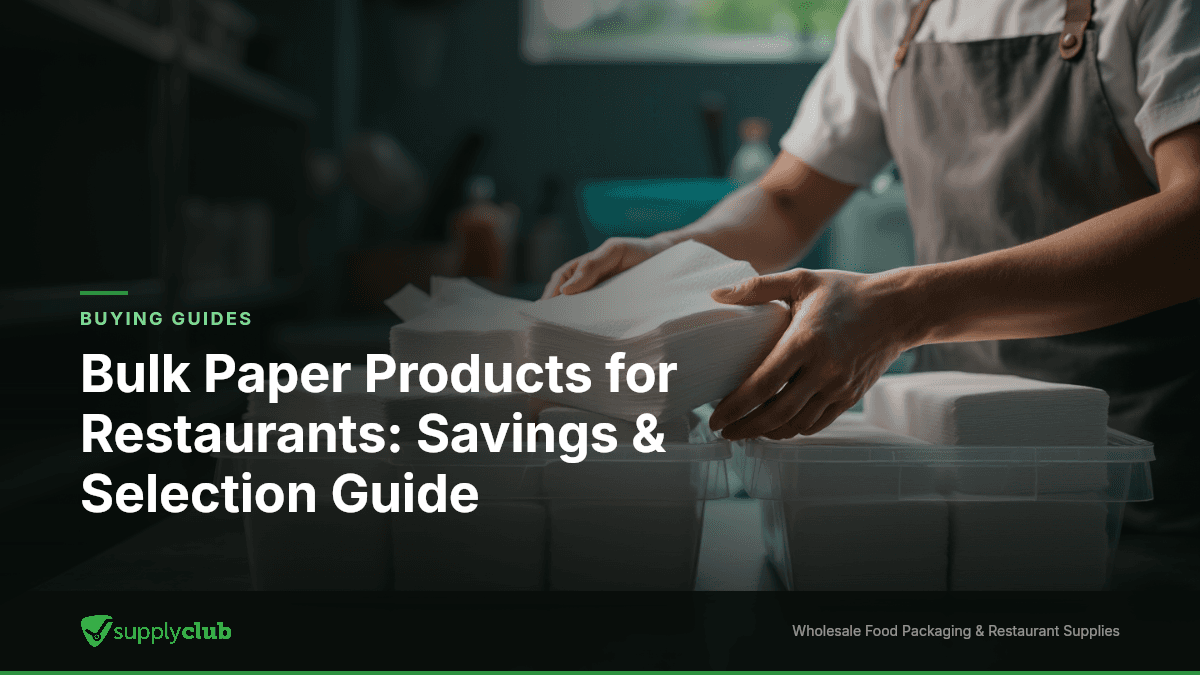
Understanding Paper Product Categories for Food Service
Every restaurant burns through bulk paper products faster than almost any other supply category. Napkins, paper towels, butcher paper, toilet tissue, shopping bags — they're all consumables that hit your budget every single month. The trick is understanding which categories matter most to your operation so you can buy smarter, not just cheaper.
Bulk paper products for food service break down into three broad buckets:
Janitorial Paper
This covers toilet paper, paper towels, and hand towels for your restrooms and kitchen handwash stations. These are non-negotiable — health codes require them, customers expect them, and your staff needs them. The main decisions here are ply count (1-ply vs. 2-ply), fold type for towels (C-fold, multifold, center-pull), and virgin vs. recycled fiber. A case of Natural Multi-fold Paper Towels at $38.60 for 4,000 towels gets you under $0.01 per towel — that's the kind of per-unit math that matters when your staff is pulling 200+ towels a day. If you're looking to buy toilet paper online in bulk, the same logic applies: per-roll cost and ply quality matter more than brand names.
Food Service Paper
Napkins, placemats, hot cups, and anything that touches the guest experience. Your front-of-house restaurant paper supplies affect perceived quality more than most operators realize. A flimsy 1-ply lunch napkin works fine for a quick-service counter. A full-service dinner house needs something like Elegant Premium 2-Ply Dinner Napkins at $86.82 for 3,000 — roughly $0.029 each. These items fall under Tableware and Tabletop and Guest Presentation categories.
Packaging Paper
This is your white butcher paper, steak paper, freezer paper, wax paper, and paper bags. Kraft paper is the workhorse here — strong, tear-resistant, and food-safe. A roll of 18" x 1000' Kraft Butcher Paper at $85.80 gives you 1,000 linear feet of wrapping material for meat stations, seafood counters, and sandwich prep. Kraft's natural brown fiber is unbleached, which makes it stronger than bleached alternatives at the same weight.
Cost Analysis: What You Actually Save Buying Bulk Paper Products
Here's the number that should stick in your head: bulk purchases on wholesale paper goods typically save 20-30% compared to buying smaller quantities from retail or broadline distributors padding margins. For a mid-volume restaurant spending $800-$1,200 per month on paper supplies, that translates to $2,000-$4,000 in annual savings.
Industry benchmarks say packaging and paper costs should run 3-4% of net sales for quick-service restaurants, and 1-2% for full-service. If you're above those numbers, you're either over-ordering, using premium products where basic ones would work, or buying at retail markups.
Here are real numbers from current catalog pricing:
| Product | Case Price | Units/Case | Cost Per Unit |
|---|---|---|---|
| Natural Multi-fold Paper Towel | $38.60 | 4,000 | $0.0097 |
| GP PRO Pacific Blue C-Fold Paper Towel | $86.28 | 1,440 | $0.0599 |
| 100% Recycled 2-Ply Bath Tissue | $88.44 | 96 rolls (500 sheets each) | $0.92/roll |
| Elegant 2-Ply Dinner Napkins | $86.82 | 3,000 | $0.029 |
| White Steak Paper Sheets | $38.46 | 1,000 | $0.038 |
| White Senior Shopping Bag w/ Handles | $134.20 | 250 | $0.537 |
The spread between the multi-fold towel at under a penny per sheet and the premium C-fold at $0.06 is significant. If your kitchen uses 300 towels a day, that's $2.91/day vs. $17.97/day — a difference of over $5,500 per year on one product alone. The C-fold is a nicer towel, absolutely. But does your kitchen prep station need it? Probably not. Save the GP PRO Pacific Blue Select™ C-Fold for your customer-facing restrooms where quality matters.
The flip side: mismanaged inventory — over-ordering, spoilage from bad storage, theft — costs food service businesses roughly 10% of their supply budget. Buying bulk only saves money if you actually use what you buy before it gets damaged or lost.
Pro Tip: Track your per-unit cost on every paper product, not just the case price. A $38 case of 4,000 towels beats a $86 case of 1,440 on cost-per-use, even though the second case looks "cheaper" on the invoice. Post your per-unit costs on a kitchen whiteboard so staff understands what waste actually costs.
Product Selection Guide by Application
Choosing paper products by application — not by price alone — prevents the classic mistake of buying the cheapest option and watching your staff burn through twice as much.
Kitchen Prep and Back-of-House
Your prep stations need butcher paper for wrapping proteins, steak paper for separating cuts, and freezer paper for cold storage. The Gordon Paper 9" x 12" 40# White Steak Paper Sheets at $0.038 per sheet are ideal for delis and butcher counters — the 40-pound weight provides enough barrier to prevent moisture transfer between stacked cuts without being overkill.
For freezer storage, standard butcher paper won't cut it. You need a PE-lined product like Gordon Paper Freez-Well Premium 18" x 1000' Freezer Paper at $91.86 per roll. The PE coating prevents freezer burn and moisture migration. Regular kraft paper in a freezer will let ice crystals form on your proteins within days.
For general kitchen hand-drying and surface wiping, the Natural Multi-fold Paper Towel is the right call. At under a penny per towel, you won't cringe when a line cook grabs a handful.
Front-of-House and Guest-Facing
Napkins are where most operators under-spend or over-spend. A casual counter-service spot can run Elegant 1-Ply Lunch Napkins at $67.08 for 6,000 — just over a penny each. A steakhouse or upscale bistro should step up to 2-ply dinner napkins.
Hot beverage service requires PE-lined paperboard cups. The 24 oz. Carte Blanc® Paper Hot Cup at $156.98 per 500 ($0.314 each) uses polyethylene lining to prevent leaks and maintain structural integrity at high temperatures. This falls under Beverage Cups — a separate procurement category from your paper supplies, but one that runs on the same bulk-buying math.
Takeout and Delivery
Carryout operations need sturdy paper shopping bags. The White Senior Paper Shopping Bag with Handles at $0.537 per bag handles heavier orders. Pair these with takeout containers and you've covered the delivery packaging stack. For lighter items or bakery runs, white paper lunch bags bring the per-unit cost down significantly. Brands like Bagcraft Packaging also offer specialty wax-lined bags — the Bagcraft 4 lb. Dubl-Wax® White Bag at $99.44 for 1,000 ($0.099 each) is a solid pick for greasy items like donuts or fried chicken where standard paper would soak through.
Janitorial and Restrooms
Restroom paper is a cost center, not a revenue driver. But skimping too hard backfires — thin 1-ply toilet tissue that falls apart means customers use three times as much. A case of 100% Recycled 2-Ply Bath Tissue at $88.44 for 96 rolls ($0.92/roll) is solid for a mid-traffic restroom. It's 100% recycled content, so it checks the sustainability box too. Don't forget trash bags — they're not paper, but they're part of the same restroom supply order.
Storage Requirements and Space Planning
Buying bulk means nothing if your storage can't handle it. Paper products are bulky, light, and extremely sensitive to moisture. One leaky pipe or one case stored on the floor near a mop sink, and you've just turned $85 worth of butcher paper into recycling.
Here are the non-negotiable storage rules for paper goods:
- Keep them dry. Paper absorbs moisture from the air. Store cases off the floor on wire shelving, at least 6 inches above ground level. Humidity above 65% starts degrading paper products.
- Keep them away from chemicals. Cleaning and Janitorial chemicals stored next to paper products can transfer odors and contaminants. Health inspectors flag this.
- Keep them cool but not cold. Moderate temperatures (50-75°F) are fine. Extreme heat makes adhesives on PE-coated products fail. Don't store paper in a hot attic above the kitchen.
- Use FIFO rotation. First in, first out. New cases go to the back. Old cases come forward. Paper doesn't expire, but boxes sitting for months get crushed, dusty, and forgotten.
Space planning is the real constraint for smaller operations. A case of 4,000 multi-fold towels takes up about 1.5 cubic feet. A roll of 18" x 1000' butcher paper is roughly 18" long and 10" in diameter. Map out your dry storage shelving and calculate how many cases fit per shelf before you commit to a six-month supply.
Pro Tip: Invest $112 in an 18" Deluxe Paper Dispenser and Cutter for your butcher paper. Wall-mounted dispensers save counter space, reduce waste from uneven tearing, and speed up your prep line. The dispenser pays for itself in two months of reduced paper waste.
For small kitchens and food trucks, the space math often dictates ordering frequency more than price breaks. A food truck with 20 cubic feet of total dry storage can't hold a three-month supply of everything. Order your high-volume items (napkins, paper towels) in bulk, and your low-volume items (freezer paper, shopping bags) in smaller quantities more frequently.
Material Types and Quality Considerations
Not all paper is created equal. Understanding material grades helps you match the right product to the right job — and avoid paying for performance you don't need.
Kraft Paper
Kraft paper is made from wood pulp using the kraft process, which produces long, strong fibers. Virgin kraft (unbleached) is the strongest paper material available for food service. It's the natural brown color you see on butcher paper and paper bags. Kraft paper comes in different weights measured in pounds (lb) per ream — 40# is standard for steak paper, while heavier weights (50-60#) are used for butcher and wrapping applications.
Grade matters. Virgin Grade 1 kraft uses 100% fresh fiber for maximum strength and food safety. Recycled kraft blends post-consumer fiber back in, which reduces strength slightly but lowers cost and environmental impact. For wrapping raw proteins, stick with virgin kraft. For dry goods and general packaging, recycled works fine.
PE-Lined Paperboard
Polyethylene-lined paper is what makes hot cups and freezer paper work. The PE coating creates a moisture barrier that plain paper can't provide. This is essential for any application involving liquids or freezer storage. The tradeoff: PE-lined products are not compostable. The plastic lining prevents standard composting.
SBS Paperboard
Solid Bleached Sulfate (SBS) paperboard is the white, smooth-finish material used in premium packaging and belly bands. It takes printing well and looks clean. The Kraft Paper Belly Band, 18pt SBS at $80.00 per 500 units ($0.16 each) is a good example — it combines SBS structure with a kraft finish for branded food presentation.
Recycled and Sustainable Options
The U.S. paper recycling rate hovers around 68%, making paper one of the most recycled materials in the country. Modern recycled paper products perform comparably to virgin fiber for most food service applications. The 100% Recycled 2-Ply Bath Tissue is a strong example — it delivers the same 500 sheets per roll at 2-ply thickness using entirely post-consumer recycled content.
Look for FSC (Forest Stewardship Council) certification on virgin paper products. It confirms responsible sourcing. For operations marketing sustainability, recycled and FSC-certified paper products are an easy win with customers.
Sheets and Wrap is where you'll find the widest range of material options — everything from standard kraft to specialty coated papers for specific kitchen applications.
Pro Tip: When choosing between bleached (white) and unbleached (brown) paper products, remember that bleaching adds cost without adding strength. Unbleached kraft is stronger and cheaper. Use white paper where appearance matters to guests (steak paper under displayed cuts, shopping bags for carryout) and brown everywhere else.
Calculating Order Quantities and Timing
Over-ordering ties up cash and storage space. Under-ordering means emergency runs to a retail store at double the price. Here's a practical method to find your sweet spot.
The Two-Week Tracking Method
- Track actual usage for 14 days. Count how many napkins, towel cases, rolls of butcher paper, and bags you go through. Don't estimate — count.
- Multiply by two to get your monthly baseline.
- Add a 20% buffer for busy periods, waste, and unexpected needs.
- Compare against storage capacity. If the result exceeds your shelf space, split the order into two monthly deliveries.
Example: You track 150 multi-fold towels per day over two weeks (2,100 total). Monthly estimate: 4,200 towels. With 20% buffer: 5,040. One case of Natural Multi-fold Paper Towels gives you 4,000. So you need about 1.25 cases per month — order 2 cases every 6 weeks, or 1 case monthly and accept a slight shortfall risk.
Par Levels by Category
Set minimum stock levels (par levels) that trigger reorders:
- Paper towels: 2-week supply minimum on hand
- Toilet paper: 3-week supply (you never want to run out)
- Napkins: 2-week supply
- Butcher/steak paper: 1-month supply (one roll lasts most small operations weeks)
- Shopping bags: 2-week supply for takeout-heavy operations
Seasonal Adjustments
Takeout and delivery operations see 20-40% volume increases during holidays and bad weather. If you run a heavy delivery model, bump your bag and food container orders by 30% heading into November and December. Summer patio seasons increase napkin usage. Track your seasonal patterns year over year and adjust par levels accordingly.
Cash flow matters too. Tying up $500 in a three-month paper towel supply might look good on per-unit cost, but if that $500 could be serving you better elsewhere in January, a smaller more frequent order makes more financial sense. Balance the bulk discount against your actual cash position. For a deeper look at how to evaluate total cost of ownership on your food service paper products, check out the understanding product pricing guide.
Frequently Asked Questions
What's the shelf life of bulk paper products?
Paper products don't expire. Stored properly in a clean, dry environment, they last indefinitely. The enemies are moisture, pests, and chemical contamination — not time. Keep cases sealed until needed, store them off the floor on shelving, and they'll be perfectly fine whether you use them in a week or a year.
Should I always buy the cheapest paper product available?
No. Low-quality napkins prompt customers to grab 3-4 instead of one. Thin paper towels require double-pulls at the dispenser. A single-ply toilet paper that disintegrates costs you more in usage volume than a decent 2-ply. Calculate your true cost per use, not just cost per unit. If a $0.029 dinner napkin replaces two $0.011 lunch napkins, the "expensive" option is actually cheaper.
How do I know if I have enough storage space for bulk orders?
Measure your available dry storage shelving — height, width, and depth. Get case dimensions from product listings (or measure a case you already have). Most standard paper towel cases are about 24" x 12" x 10". Calculate how many cases fit per shelf, then compare against your monthly consumption. If you can't fit a full month's supply with room to spare for other items, order more frequently in smaller quantities.
Are recycled paper products as strong as virgin fiber products?
For most food service applications, yes. Modern recycled paper towels, napkins, and toilet tissue perform comparably to virgin products. The one area where virgin fiber still wins decisively is heavy-duty kraft wrapping for raw proteins — virgin kraft has longer fibers that resist tearing under wet conditions. For everything else, recycled content delivers solid performance at a lower environmental cost.
What's the difference between kraft paper and butcher paper?
Kraft paper is a category of paper made using the kraft pulping process. Butcher paper is a specific type of kraft paper designed for wrapping meat — it's FDA food-grade, usually 40-60# weight, and available in bleached (white) or unbleached (brown) versions. All butcher paper is kraft paper, but not all kraft paper is food-safe butcher paper. Always verify FDA compliance before using any paper in direct food contact.
How can I reduce paper product waste in my operation?
Three strategies work consistently. First, install proper dispensers — a wall-mounted paper towel dispenser that controls sheet count reduces usage by 20-30% compared to open-stack towels. Second, right-size your products. Don't put full-size dinner napkins at a casual counter; use lunch napkins instead. Third, train staff. A five-minute conversation about per-unit costs makes employees more conscious about grabbing fistfuls of towels. Post the cost-per-unit on a sign near the dispenser.
Buying bulk paper products is one of the simplest ways to cut recurring costs in any food service operation. Match your product choices to actual applications, calculate per-unit costs religiously, and store your inventory properly. SupplyClub carries the full range of wholesale paper goods covered in this guide — from kraft butcher paper to recycled bath tissue — with transparent per-unit pricing and no minimum order requirements. Browse the catalog and start building your next paper supply order today.
Keep Reading
Broadline Distribution Alternative: Why Smaller Suppliers Win
Mega-distributors like Sysco and US Foods bake hidden markups into pricing through rebate layers, overhead costs, and...
Buying Janitorial Supplies in Bulk Online: A Guide
A practical guide for restaurant operators on buying janitorial supplies in bulk online to cut costs, stay health-code...
Sustainable School Lunches: Eco-Friendly Disposable Options for Educational Cafeterias
Explore SupplyClub's eco-friendly disposable options for school cafeterias, including plant-based bowls and plates, to...