
Buying Janitorial Supplies in Bulk Online: A Guide
SupplyClub Team
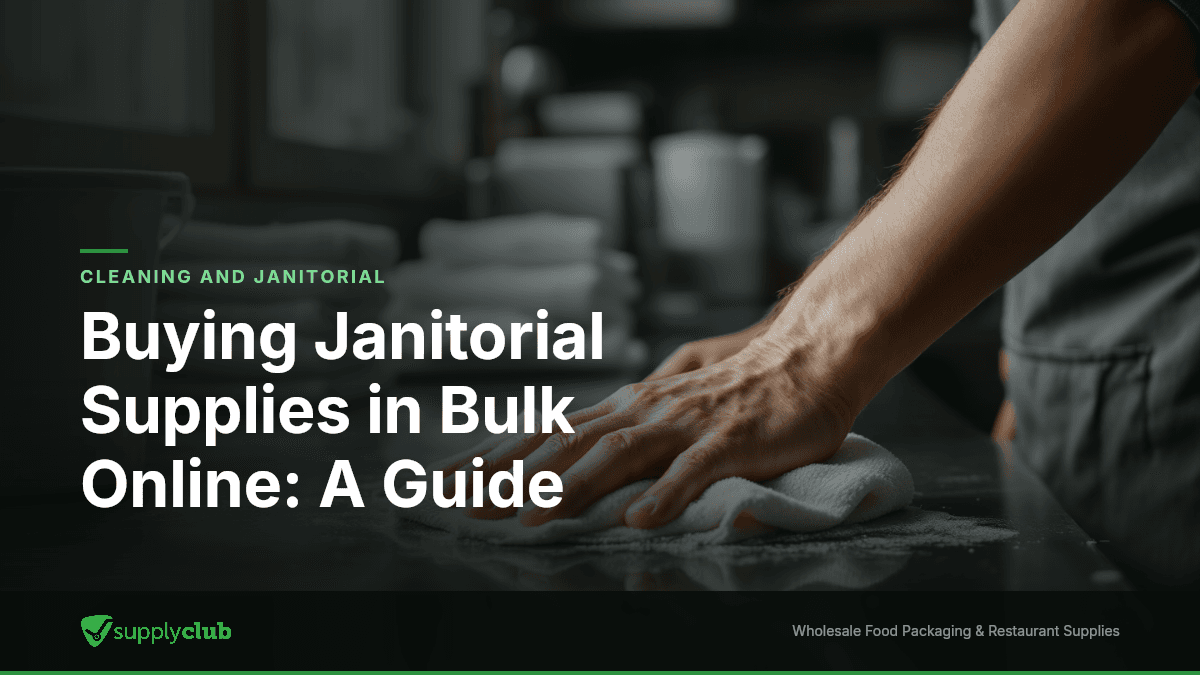
Why Food Service Operations Need a Different Approach to Janitorial Supplies
A health inspector doesn't care that your dining room looks spotless if your sanitizer concentration is wrong. Restaurants operate under a completely different set of rules than office buildings or retail stores when it comes to cleaning. The FDA Food Code requires specific sanitation protocols at every critical control point in your operation — from prep surfaces to handwashing stations to restroom maintenance. That's exactly why buying janitorial supplies in bulk online has become a strategic priority for food service operators who need reliable, food-safe products at scale.
The stakes are real. A single health code violation for improper sanitation can result in fines ranging from $100 to $1,000 per violation, and repeat offenses can shut you down. Beyond fines, a poor inspection score posted publicly will cost you customers faster than a bad Yelp review. Your cleaning and janitorial supplies aren't an afterthought — they're a compliance requirement.
Here's what makes restaurant janitorial different: you need food-safe products. Not every degreaser belongs near a prep surface. Not every wiper is rated for foodservice contact. Cross-contamination isn't just about raw chicken touching cooked vegetables — it also happens when you use the same rag to wipe down a toilet and then a dining table. Color-coded cleaning systems, food-safe chemical concentrations, and powder-free gloves for allergen-awareness environments are baseline requirements, not nice-to-haves.
Running out of gloves during a Friday dinner rush isn't an inconvenience. It's a food safety violation waiting to happen. Bulk purchasing protects your compliance, controls costs, and ensures you never scramble for essentials during service.
The True Cost Savings of Buying Janitorial Supplies in Bulk Online
The per-unit math is the obvious starting point. Buying a case of 1,000 nitrile gloves instead of grabbing a box of 100 from a local supply house typically saves you 30-40% per glove. But per-unit savings are just one piece of the picture.
Consider the time cost of frequent reordering. If your manager spends 30 minutes twice a week comparing prices, placing orders, receiving deliveries, and restocking supply closets, that's roughly 52 hours per year at a single location dedicated to janitorial procurement alone. For a multi-unit operator, multiply that across locations — you're easily looking at 100+ hours annually. That's a part-time employee's worth of hours spent on paper towels and trash bags.
Shipping adds up fast when you order small quantities frequently. A single case of wipers might cost $8-12 to ship. Order five cases at once and you're often looking at free or heavily discounted freight. Over twelve months, consolidating your janitorial orders into monthly bulk purchases can save $500-1,500 in shipping alone, depending on your volume.
Then there's price stability. Cleaning supply costs fluctuate with raw material prices and supply chain disruptions. When you buy in bulk, you lock in today's price for three to six months of inventory. That predictability makes budgeting easier and protects your margins.
Pro Tip: Don't bulk-buy everything equally. Focus your largest orders on high-turnover consumables — gloves, wipers, trash liners, and toilet paper. Specialty items like stainless steel polish or urinal screens move slowly and tie up cash when over-purchased.
Here's a simple framework for calculating your bulk buying ROI:
| Cost Factor | Small Orders (Monthly) | Bulk Orders (Quarterly) |
|---|---|---|
| Nitrile Gloves (per unit) | $0.18 | $0.13 |
| Shipping (annual) | $1,200+ | $300-500 |
| Staff Time (annual hours) | 100+ | 25-35 |
| Price Volatility Risk | High | Low |
That said, bulk buying only works when it aligns with your actual consumption rate. Buying a two-year supply of a concentrated degreaser you use once a week is dead capital sitting on a shelf. Match your purchase quantities to realistic usage windows of 60-90 days for most products.
Essential Janitorial Supply Categories for Restaurants
Your janitorial needs break down into five functional areas. Here's what belongs in each, with specific product recommendations that hold up in commercial kitchens.
Restroom Essentials
Toilet paper and paper towels are your highest-volume restroom consumables. Switching to jumbo roll dispensers drastically cuts restocking frequency. A 9" Double Jumbo Roll Bath Tissue Dispenser at $63.08 holds twice the paper of a standard dispenser, which means your staff isn't ducking into restrooms every hour during a busy brunch. For smaller operations, the 9" Single Jumbo Roll Bath Tissue Dispenser at $41.90 is a solid entry point.
Hand soap, sanitizer dispensers, and urinal screens round out the restroom category. Don't skip on bathroom supplies — restroom condition is the number one thing customers use to judge your overall cleanliness.
Kitchen Cleaning
This is where food safety lives. You need wipers and towels rated for foodservice use. The Shore Manufacturing 12.5" x 24" White Heavy-Duty Multi-Purpose Wiper comes in a 300-unit case at $76.38 — that's roughly $0.25 per wiper for heavy-duty commercial cleaning. For foodservice-specific tasks, the Shore Manufacturing Yellow Heavy-Duty Foodservice Wiper at $54.56 per 150-unit case gives you color-coded identification that prevents cross-contamination between kitchen zones.
Gloves are non-negotiable. The Emerald 6X Large Black Nitrile Exam Gloves come in 1,000-unit cases at $126.00 — that's $0.13 per glove. They're latex-free and powder-free, which matters for allergen awareness in your kitchen. At 6 mil thickness, they hold up to prep work without tearing.
Waste Management
Trash bags and trash cans are the backbone of waste management. Buy liners by the case and match them to your can sizes. Nothing is more wasteful than using a 55-gallon liner in a 33-gallon can because someone grabbed the wrong box.
Odor Control
Restroom odor is a silent customer killer. The Big D Concentrated Mountain Air Room Deodorant at $102.42 for a 12-unit case is a concentrated formula — meaning each unit goes further than standard air fresheners. Pair it with a Big D Fully Programmable Aerosol Dispenser at $84.04 for a 20-unit case to automate the process. Programmable dispensers ensure consistent coverage without relying on staff to remember.
Surface Care
Stainless steel equipment shows every fingerprint and grease smudge. The Twinkle 17 oz Stainless Steel Cleaner & Polish at $193.64 per 12-unit case keeps your kitchen equipment looking professional. This is a slower-moving product — one case might last a smaller operation six months — so don't overbuy.
How to Calculate Your Actual Bulk Supply Needs
Before placing a large bulk order, you need to know what you actually use. Guessing leads to overstocked supply closets or, worse, running out mid-shift. Here's a practical framework.
Step 1: Audit Current Usage
Pick a representative two-week period and track consumption by area. How many gloves does your kitchen go through per shift? How many trash liners per day? How often are you restocking toilet paper? Write it down. Simple tally marks on a clipboard near each supply station work fine.
Step 2: Factor in Variability
Your Tuesday lunch and your Saturday dinner have very different supply demands. Look at your POS data to identify peak periods. If weekend volume is 2x your weekday average, your supply consumption scales roughly proportionally. Catering events and seasonal spikes (patio season, holiday parties) need their own projections.
Step 3: Assess Storage Capacity
Bulk buying only works if you have somewhere to put things. Measure your storage space and calculate how many cases of each product you can realistically hold. Chemical products need proper ventilation and separation from food storage areas. Paper products need dry storage away from moisture.
Step 4: Set Par Levels and Reorder Points
A par level is the minimum quantity you should have on hand at all times. Your reorder point is the quantity that triggers a new purchase, factoring in supplier lead times. If your glove supplier takes five business days to deliver and you go through 500 gloves per week, your reorder point is at least 700-800 gloves (one week of usage plus a buffer).
Pro Tip: Standardize on versatile products wherever possible. A heavy-duty multi-purpose wiper that works in both the kitchen and the dining room means one SKU instead of three. Fewer SKUs means simpler inventory tracking and fewer chances of running out of something obscure.
What to Look for When Buying Janitorial Supplies in Bulk Online
Not all online suppliers are equal. Price per case is the obvious comparison point, but it's not the only one that matters. Here's what separates a good online supplier from one that will cost you more in the long run.
Food-Safe Certifications
Every product that will be used in or near food preparation areas needs to be rated for foodservice use. Look for NSF certification, FDA compliance documentation, and food-contact-safe ratings. This applies to wipers, gloves, sanitizers, and surface cleaners. A cheaper industrial degreaser that isn't food-safe will cost you far more when a health inspector flags it.
True Cost Per Use
Case price is misleading without context. A $50 case of 100 wipers costs $0.50 per wiper. A $76 case of 300 wipers from the wipers and rags category costs $0.25 per wiper. The second option is half the cost per use despite a higher case price. For concentrated cleaning chemicals, calculate the diluted cost — a product that dilutes 1:64 goes 64 times further than a ready-to-use spray.
Transparent Pricing
Hidden fees kill your savings. Some suppliers advertise low case prices but tack on membership fees, handling charges, or inflated shipping costs. Look for suppliers that show per-unit pricing upfront and don't require minimum order quantities to access bulk pricing.
Shipping Reliability
A great price means nothing if your order shows up a week late — or damaged. Check supplier reviews for shipping accuracy and packaging quality. Consistent, predictable delivery windows let you plan your inventory management around actual arrival dates rather than hopeful estimates.
Product Consistency
Brand reliability matters more with janitorial supplies than people think. If your kitchen staff trains on a specific wiper thickness and absorption level, switching to a cheaper alternative that tears on contact creates waste and frustration. Stick with established foodservice brands like Shore Manufacturing for wipers and Emerald for gloves.
Building an Inventory Management System That Actually Works
You don't need expensive software to manage janitorial inventory effectively. Most single-location restaurants can run a tight system with a clipboard, a spreadsheet, and one designated person. If you want to apply similar principles to your food packaging procurement, the same logic from this guide to buying paper products in bulk applies to janitorial supplies.
Assign Ownership
The fastest way to run out of supplies is to make it "everyone's job." Designate one person — typically a shift manager or kitchen lead — as the supply manager. They're responsible for weekly counts, reorder requests, and receiving deliveries. One point of accountability eliminates the "I thought someone else ordered it" problem.
Create a Par Stock List
List every janitorial product you use, its par level, its reorder point, and its preferred supplier. Post this list in your storage area. A simple spreadsheet with columns for product name, current count, par level, reorder point, and last order date covers 90% of what you need.
Use the Two-Bin System for Critical Items
For supplies you absolutely cannot run out of — gloves, trash liners, toilet paper — use a two-bin system. When the first bin empties, you start using the second and immediately reorder. This builds a physical buffer into your system without any technology required.
Apply FIFO to Your Supply Closet
First In, First Out isn't just for food storage. Cleaning chemicals have shelf lives. Concentrated products can separate or lose effectiveness over time. Apply date labeling principles to your chemical storage — mark the date received on each case and rotate older stock to the front. This is especially relevant for aerosol products and concentrated cleaners.
Store Products Properly
Chemical products need to be stored away from food items, at proper temperatures, and in well-ventilated areas. Paper products need dry storage — a leaky pipe above your toilet paper stock will destroy a $200 order overnight. Keep your storage area organized with clear labeling so staff can find what they need without digging through boxes.
Pro Tip: Do a 15-minute supply walk every Monday morning. Check par levels, note anything running low, and place your order before the week gets hectic. This one habit prevents 90% of emergency supply runs.
Common Bulk Buying Mistakes and How to Avoid Them
Bulk purchasing is straightforward, but there are recurring mistakes that cost food service operators money. Here are the ones worth watching for.
Comparing Only by Case Price
This is the most common mistake. A case of 100 wipers for $42.82 looks cheaper than a case of 300 for $76.38. But the per-unit cost of the smaller case is $0.43, while the larger case works out to $0.25. Always calculate cost per unit or cost per use before comparing options.
Buying Products That Don't Fit Your Operation
Industrial-grade floor strippers designed for warehouse floors are overkill (and potentially unsafe) for a restaurant kitchen. Vinyl gloves are fine for general cleaning but don't offer the puncture resistance you need for kitchen prep — nitrile is the better choice there. Match the product to the actual use case.
Ignoring Food-Safe Ratings
This one can get you shut down. Before bulk purchasing any cleaning product, verify it's rated for food service environments. Products used near food contact surfaces must comply with FDA regulations. The cheapest all-purpose cleaner on the internet is worthless if it triggers a health code violation.
Over-Purchasing Slow-Moving Specialty Items
Stainless steel polish, oven cleaner, drain treatments — these products move slowly. Buying a year's supply ties up capital and storage space. Limit specialty product orders to a 60-90 day supply. Save your bulk purchasing power for high-turnover consumables.
Neglecting Storage Conditions
Storing aerosol cans near heat sources is a safety hazard. Keeping paper products in damp basements leads to waste. Stacking heavy cases on top of lighter products crushes packaging. Proper storage is part of the cost equation — if 10% of your bulk purchase is damaged due to poor storage, you've wiped out most of your savings.
Not Accounting for Supplier Lead Times
If your supplier takes 7-10 business days to deliver and you wait until you're nearly out to reorder, you'll end up making an expensive emergency run to a local supply house. Build lead times into your reorder calculations. Food safety compliance is directly related to proper temperature management and avoiding the danger zone, but it's equally dependent on having the right cleaning supplies on hand when you need them.
Frequently Asked Questions
How much can restaurants save buying janitorial supplies in bulk?
Most food service operations save 30-40% on per-unit costs when purchasing janitorial supplies in bulk versus buying small quantities from local distributors. The total savings are higher when you factor in reduced shipping costs and fewer staff hours spent on procurement. A mid-size restaurant spending $500/month on janitorial supplies can typically save $150-200/month by consolidating orders into quarterly bulk purchases.
What janitorial supplies should restaurants always buy in bulk?
Focus on high-turnover consumables: nitrile gloves, foodservice wipers, trash liners, toilet paper, and hand soap. These items are used daily in significant quantities, have long shelf lives, and show the biggest per-unit savings at bulk pricing. Specialty products like stainless steel polish or oven cleaners should be purchased in smaller quantities aligned with actual usage rates.
How do I know if cleaning products are food-safe?
Look for NSF International certification (specifically NSF/ANSI 51 for food equipment materials) and FDA compliance documentation. Products used on food contact surfaces must meet specific regulatory standards. Reputable foodservice supply brands clearly label their products for food service use. When in doubt, request a Safety Data Sheet (SDS) from the supplier and verify the product's intended use includes food service environments.
How long do bulk cleaning supplies last in storage?
Most paper products (wipers, toilet paper, paper towels) last indefinitely if stored in dry conditions. Concentrated cleaning chemicals typically have a shelf life of 1-2 years when stored at room temperature away from direct sunlight. Aerosol products generally last 2-3 years. Always check manufacturer recommendations and apply date labeling when you receive new inventory. Nitrile gloves maintain their integrity for 3-5 years in proper storage.
Do I need special permits to store bulk cleaning chemicals?
For typical restaurant quantities — even in bulk — you generally don't need special permits. However, local fire codes may restrict the total volume of flammable or aerosol products you can store in a single location. Check with your local fire marshal if you're storing more than a few cases of aerosol products. Keep Safety Data Sheets accessible for all chemicals on-site, which is an OSHA requirement regardless of quantity.
What's the best way to prevent cross-contamination with cleaning supplies?
Implement a color-coded cleaning system. Use one color wiper for kitchen food contact surfaces, another for dining areas, and a third for restrooms. The housekeeping and cleaning category includes wipers in multiple colors specifically for this purpose. Train every staff member on the system and post visual guides in each area. Never use restroom cleaning tools in food preparation zones under any circumstances.
Is there a minimum order quantity for bulk janitorial pricing?
This varies widely by supplier. Some wholesale distributors require minimum orders of $250-500 or multiple cases per SKU to unlock bulk pricing. Others offer per-unit wholesale pricing on every order regardless of size. Before committing to a supplier, confirm whether you need to hit a minimum threshold — especially if you're a smaller operation that can't justify ordering 20 cases at once.
Can I return bulk janitorial supply orders that don't work out?
Return policies differ significantly between suppliers. Most accept returns on unopened, undamaged cases within 30 days, but restocking fees of 15-25% are common on bulk orders. Chemical products and opened cases are typically non-returnable for safety reasons. Always read the return policy before placing a large order, and consider ordering a single case of a new product to test before committing to bulk quantities.
Buying janitorial supplies in bulk online is one of the most practical moves you can make for your food service operation. It protects your bottom line, keeps you compliant, and eliminates the stress of running out of essentials during a rush. SupplyClub carries a curated selection of foodservice-rated janitorial products with transparent per-unit pricing and no minimum order requirements — so you can buy what you need, when you need it, at wholesale prices.
Keep Reading
Broadline Distribution Alternative: Why Smaller Suppliers Win
Mega-distributors like Sysco and US Foods bake hidden markups into pricing through rebate layers, overhead costs, and...
Bulk Paper Products: A Procurement Guide for Food Service
A practical procurement guide to bulk paper products for food service — covering paper towel formats, toilet paper,...
Bulk Paper Products for Restaurants: Savings & Selection Guide
A practical guide to buying bulk paper products for restaurants, covering cost-per-unit calculations, material types,...