
PLA Deli Containers: Features, Benefits & Safety Guide
SupplyClub Team
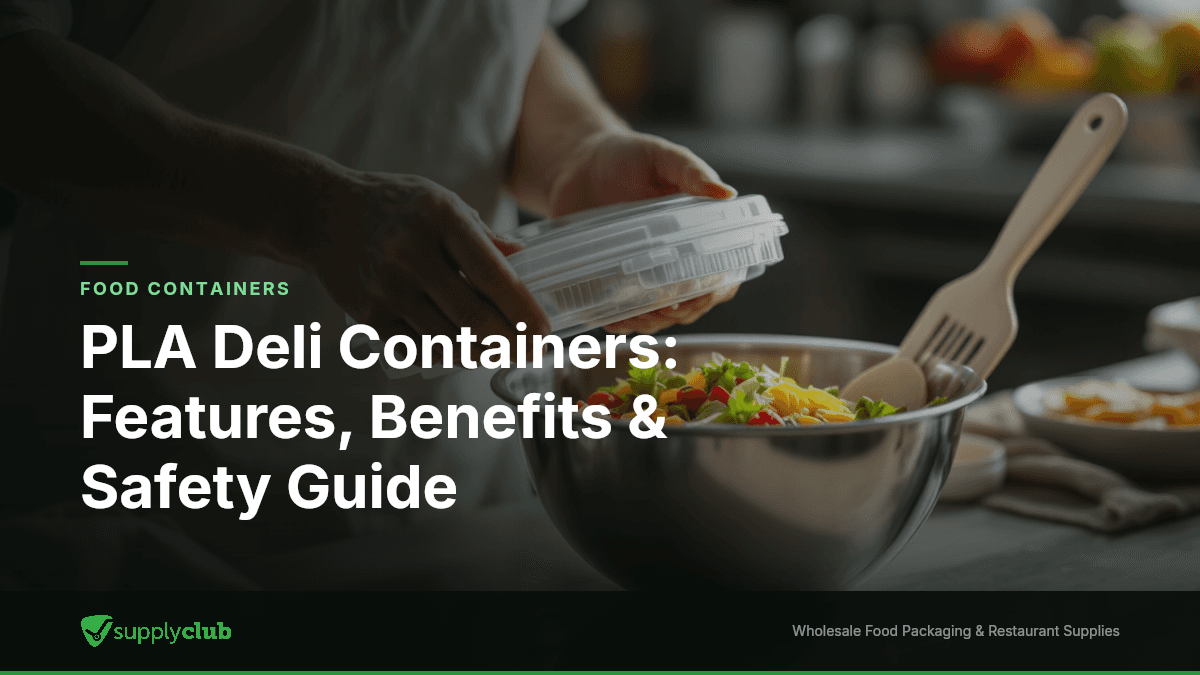
What Are PLA Deli Containers? Material Composition & Manufacturing
PLA deli containers look like regular plastic. They feel like regular plastic. But they're made from plants — specifically, the starches extracted from corn, sugarcane, or cassava root. PLA stands for polylactic acid, a bioplastic that's polymerized from plant sugars through fermentation and chemical processing.
Here's the critical distinction most operators miss: PLA is a bioplastic, not a magic material. It requires specific industrial composting conditions to break down. Tossing a PLA container into your backyard compost bin does nothing. It'll sit there for years looking exactly the same. But put it in a commercial composting facility running at 55-60°C with proper moisture management, and it breaks down in about 12 weeks.
The major brands manufacturing PLA deli containers include Fabri-Kal (their Greenware line), Eco-Products, World Centric, Placon, and Stalk Market. All produce FDA-approved, food-contact-safe containers. Many carry USDA BioPreferred certification, confirming the biobased content. The Fabri-Kal GS6-4 Greenware 28 oz Deep 4-Compartment Container is a solid example — a multi-compartment option built for meal kits and portion-controlled cold items.
One more thing to understand upfront: PLA containers are designed exclusively for cold and lukewarm foods. If you need hot-food containers, stop here and look at polypropylene or bagasse fiber options instead. PLA and heat don't mix — literally.
Key Features & Performance Characteristics of PLA Deli Containers
The biggest selling point for PLA containers is crystal-clear visibility. They rival PET in optical clarity, which matters when you're merchandising grab-and-go salads, fruit cups, or deli sides in a display case. Customers eat with their eyes first, and PLA lets them see exactly what they're buying.
PLA containers stack cleanly, which helps with back-of-house storage efficiency. They're lightweight — comparable to traditional plastic — and most designs offer leak-resistant seals. But pay attention to this distinction: leak-resistant is not airtight. PLA containers can handle dressings, vinaigrettes, and light oils without leaking, but they're not designed for liquid-heavy applications like soups or broths. For those, you need dedicated soup containers.
Temperature range is the most important spec to memorize. Most PLA containers are rated for cold foods up to 105-120°F maximum, depending on the manufacturer. Fabri-Kal rates their Greenware line to about 120°F. Stalk Market is more conservative at 105°F. Either way, you cannot microwave PLA. The container will warp, distort, and potentially contaminate your customer's food.
PLA containers are freezer-safe, which is a genuine operational advantage. You can prep cold items, seal them in PLA containers, and freeze for extended storage without cracking or degradation. Universal lid compatibility is another plus — standard round sizes (8 oz, 12 oz, 16 oz, 24 oz, 32 oz) typically share lid systems. The Eco-Products Compostable Clear PLA Round Deli Container Lid fits across multiple container sizes, which simplifies your inventory.
Pro Tip: Test PLA containers with your specific menu items before committing to a large order. High-acid foods (citrus-heavy dressings, tomato-based salads) can interact differently with PLA than with PET. Most perform fine, but a 30-day trial run eliminates surprises.
PLA vs. PET vs. PP: When to Choose Each Material
Material selection isn't about what's "best" — it's about matching the container to your specific use case. Here's the honest breakdown.
| Feature | PLA (Plant-Based) | PET (Plastic) | PP (Polypropylene) |
|---|---|---|---|
| Max Temperature | 105-120°F | 120-140°F | 275°F+ |
| Microwavable | No | No | Yes |
| Freezer Safe | Yes | Yes | Yes |
| Optical Clarity | Excellent | Excellent | Translucent/Cloudy |
| Compostable | Yes (commercial only) | No | No |
| Recyclable | No (contaminates PET) | Yes (widely) | Yes (limited) |
| Cost Premium vs. PET | 20-50% higher | Baseline | Similar to PET |
| Best For | Cold display + eco branding | Cold display + recycling | Hot foods + reheating |
Choose PLA when your operation serves cold foods and your brand identity includes a sustainability commitment. Salad bars, juice bars, health-food cafes, farmers market vendors, and corporate cafeterias with green procurement policies are natural fits.
Choose PET when you need the same clarity and cold-food performance but your local area has established recycling infrastructure and no commercial composting facility. PET is widely recyclable. PLA is not recyclable — and mixing PLA into a PET recycling stream actually contaminates the batch. The Placon Crystal Seal 16 oz Tamper-Evident Hinged Deli Base at $58.00 per case of 210 (roughly $0.28/unit) gives you PET clarity with tamper-evident security — a strong option for grab-and-go retail.
Choose PP when you need microwave compatibility or hot-food service. A 12 oz Round PP Deli Container at $44.30 for 500 units (about $0.09/unit) handles soups, hot entrees, and reheatable meals without flinching. PP is your workhorse material. It won't win any sustainability awards, but it won't warp at 200°F either.
The cost math matters. PLA containers typically run 20-50% more expensive per unit than equivalent PET containers. For a high-volume deli pushing 500 containers a day, that premium adds up fast — potentially $15-25 per day, or $450-750 per month. Make sure your customer base values the sustainability story enough to justify the spend. For a deeper look at how different container materials stack up across your full operation, check out the food packaging materials guide.
Proper Storage & Handling: Avoiding Warping & Degradation
This is where most operators get burned with PLA. The same property that makes PLA compostable — its sensitivity to heat — also makes it a storage headache if you're not careful.
Store PLA containers below 110°F in a cool, dry, temperature-controlled space. This sounds obvious until you realize where most restaurants actually store their disposables: in a back storeroom that shares a wall with the kitchen, in a closet near the dishwasher, or stacked on shelving above the hot line. All of those locations can exceed 110°F during service. Your PLA containers will warp, stick together, and become unusable.
Keep PLA away from direct sunlight. UV exposure accelerates degradation. If you're running a food truck or outdoor catering operation, this is especially relevant — don't leave cases of PLA containers sitting in a hot vehicle. A parked food truck in summer can easily hit 150°F internally. That's enough to ruin an entire case in hours.
Pro Tip: Designate a specific cool storage area for PLA containers, separate from your main kitchen storage. A basement storage room, climate-controlled closet, or dedicated shelving in your walk-in cooler works. Label the area clearly so staff don't accidentally store PLA near heat sources. Rotate stock using FIFO (first in, first out) and inspect containers for warping before each service.
Under proper conditions, PLA containers have a shelf life of 12+ months. Most manufacturers stamp a "best by" or production date on the case. Don't ignore it. Older stock that's been through temperature fluctuations may look fine but perform poorly under use — lids won't snap properly, hinges crack, and the material becomes brittle.
If you receive a shipment of PLA containers that look warped or deformed, reject them. The damage happened somewhere in the supply chain — during warehouse storage or transit in an unrefrigerated truck. This is more common during summer months. Reputable distributors will credit or replace damaged PLA shipments, so document and report immediately.
Commercial Composting vs. Home Composting: The Reality Check
Let's be blunt: the marketing around PLA composting is ahead of the infrastructure. PLA containers are technically compostable. But "compostable" has a very specific meaning that most consumers — and plenty of food service operators — misunderstand.
BPI (Biodegradable Products Institute) certification is the gold standard in the U.S. It means the product meets ASTM D6400 testing standards for biodegradation in a commercial composting facility. In Europe, the equivalent is EN 13432. These certifications guarantee that the material will break down into CO2, water, and biomass within 12 weeks under controlled industrial conditions: sustained temperatures of 55-60°C (131-140°F), managed moisture levels, and regular aeration.
Home composting does not meet these conditions. Your backyard bin runs at ambient temperature — typically 20-30°C (68-86°F). At those temperatures, PLA barely degrades. Studies show PLA in home composting conditions can take years to show any meaningful breakdown. If a customer asks whether your PLA container is "home compostable," the honest answer is no.
Checking Your Local Composting Access
Here's the bigger operational challenge: commercial composting facilities aren't everywhere. According to BioCycle and ILSR data, fewer than 200 full-scale composting facilities in the U.S. accept food-soiled compostable packaging. That sounds like a lot until you realize they're concentrated in major metro areas — Portland, San Francisco, Seattle, Minneapolis, parts of New York. Large swaths of the country have zero access.
Before committing to PLA, verify that your area has a commercial composting facility that accepts compostable packaging. Not all facilities do — some only accept food scraps and yard waste. Contact your local waste management provider or check FindAComposter.com for facility listings.
Why PLA Can't Go in the Recycling Bin
PLA cannot go in regular recycling. PLA looks identical to PET but has a different chemical structure. When PLA enters a PET recycling stream, it contaminates the entire batch, degrading the quality of recycled PET. If your municipality doesn't have commercial composting, PLA containers end up in the landfill — where they won't meaningfully biodegrade either, because landfills lack the oxygen, heat, and moisture that composting requires.
This isn't a knock on PLA. It's a reality check. PLA makes environmental sense when the composting infrastructure exists to support it. Without that infrastructure, you're paying a premium for a material that ends up in the same landfill as PET — just at a higher cost per unit.
Best Use Cases for PLA Deli Containers in Food Service
PLA containers shine brightest in cold food applications where visual presentation and sustainability messaging both matter. Here's where they earn their premium.
- Cold salad bars and prepared salads — The crystal-clear material showcases colorful ingredients. Mixed greens, grain bowls, and composed salads all look phenomenal behind PLA.
- Fresh-cut fruit and vegetable displays — Grocery delis, juice bars, and health food stores use PLA for grab-and-go fruit cups because the transparency drives impulse purchases.
- Yogurt parfaits and overnight oats — Layered foods need visibility. PLA lets customers see every layer of granola, fruit, and yogurt.
- Acai and smoothie bowls — The health-conscious customer base for these items overlaps heavily with eco-conscious consumers. PLA reinforces the brand story.
- Cold deli sides and dips — Hummus, tabbouleh, pasta salads, coleslaws. The grease resistance handles olive oil-based dressings without leaking.
- Sushi and poke bowls — Cold protein presentations benefit from the clarity. Multi-compartment options keep wasabi, ginger, and soy separate from the main portion.
- Desserts and cold bakery items — Cheesecake slices, tiramisu, mousse cups, and chilled pastries all benefit from the display-case clarity.
- Microgreens and herb packaging — Farmers market vendors and specialty grocers use PLA to package delicate herbs without the plastic guilt.
The common thread: cold food, visual merchandising, and a customer base that cares about sustainability. If you're running a barbecue joint serving pulled pork in containers, PLA isn't your material. But if you're operating a fast-casual salad concept, organic cafe, or corporate cafeteria with a sustainability program, PLA containers align perfectly with your brand promise.
For catering operations, PLA works well for cold buffet displays and boxed lunch components. Takeout containers for cold items can be PLA without issues, as long as you're not packing anything above 105°F.
Pro Tip: If you serve both hot and cold items, don't try to standardize on one container material. Run PLA for your cold menu and PP for your hot menu. Trying to use PLA for warm soups or freshly cooked entrees will result in warped containers, leaks, and customer complaints. Two materials, zero problems.
Certifications, Compliance & Food Safety Standards
PLA containers carry a stack of certifications, and understanding what each one means helps you make informed purchasing decisions — and answer customer questions with confidence.
FDA Food Contact Approval: All commercially available PLA deli containers are FDA-approved for direct food contact. The material is classified as GRAS (Generally Recognized as Safe). No special handling or food safety protocols beyond standard practice are required.
BPI Certification: The Biodegradable Products Institute tests and certifies products against ASTM D6400 standards. A BPI-certified PLA container will fully biodegrade in a commercial composting facility within 12 weeks. Look for the BPI logo on the product or its packaging. This is the certification that composting facilities check before accepting your waste stream.
CMA Certification: The Compost Manufacturing Alliance goes a step further than BPI. CMA field-tests products in real composting facilities (not just lab conditions) to verify they actually break down as claimed. Fewer products carry CMA certification, but it's a stronger guarantee of real-world compostability.
USDA BioPreferred: This federal program certifies the biobased content of products. PLA containers typically test at 90%+ biobased content. If you're selling to government accounts or institutions with green procurement mandates, USDA BioPreferred certification can be a requirement.
NSF Listing: Some PLA containers carry NSF International listings, which verify that the product meets public health and safety standards for food service equipment and supplies. NSF listing is especially relevant if you're supplying institutional accounts — hospitals, schools, and government cafeterias often require NSF-listed disposables as part of their procurement specs.
No PFAS Added: This is increasingly critical. PFAS (per- and polyfluoroalkyl substances) — sometimes called "forever chemicals" — have been found in some compostable packaging, particularly molded fiber products treated for grease resistance. PLA containers generally do not contain added PFAS, since PLA's inherent properties provide adequate grease resistance without chemical treatments. With state-level PFAS bans rolling out (California, New York, Washington already restrict PFAS in food packaging), this gives PLA an edge. Verify "No PFAS Added" status with your supplier.
State & Local Compliance: Several jurisdictions now require compostable or recyclable food packaging. San Francisco, Seattle, and Washington D.C. have banned expanded polystyrene and require compostable alternatives for many food service applications. PLA containers help you comply with these mandates. Check your local regulations — non-compliance fines range from $100 to $1,000 per violation in some jurisdictions.
World Centric, one of the major PLA container manufacturers, also carries B Corp certification — a broader social and environmental responsibility credential. While this doesn't directly affect container performance, it matters to institutional buyers and values-driven consumers who look beyond the product itself.
FAQ: Common Questions About PLA Deli Containers
Can PLA containers be microwaved?
No. PLA begins to soften and warp at temperatures above 105-120°F, well below microwave operating temperatures. Microwaving a PLA container will deform it, potentially creating leaks and releasing food into the microwave. If customers need to reheat food, they should transfer it to a microwave-safe dish first. For hot food applications, use PP containers instead — the 12 oz Round PP Deli Container handles microwave temperatures without issues.
Are PLA containers recyclable?
No. This is one of the most common misconceptions. PLA looks like PET plastic but has a completely different chemical structure. If PLA enters a PET recycling stream, it contaminates the batch and degrades the quality of recycled PET output. PLA containers should go to a commercial composting facility — not the recycling bin. If no composting facility is available in your area, PLA unfortunately goes to landfill, where it won't meaningfully biodegrade.
How long do PLA containers take to compost?
In a commercial composting facility operating at 55-60°C with managed moisture and aeration, PLA containers biodegrade within 12 weeks. In a home composting setup (ambient temperature of 20-30°C), PLA barely breaks down at all — it could take years to show any visible degradation. In a landfill, PLA does not biodegrade because landfills lack the heat, oxygen, and moisture that composting requires.
Are PLA containers more expensive than PET?
Yes. PLA containers typically carry a 20-50% price premium over comparable PET containers. The exact premium varies by size, manufacturer, and order volume. For a high-volume operation using 500+ containers daily, this can translate to $450-750 per month in additional cost. The premium is driven by higher raw material costs and smaller production scale compared to conventional plastics. Weigh this against the value of your sustainability positioning and any regulatory requirements in your jurisdiction.
Can PLA containers hold hot foods like soup?
No. PLA is rated for cold and lukewarm foods only, with a maximum temperature of 105-120°F depending on the manufacturer. Hot soup (typically served at 165°F+) will warp and potentially collapse a PLA container within seconds. For hot soups and broths, use PP containers or insulated paper soup containers designed for high temperatures.
Are PLA containers safe for freezer storage?
Yes. PLA containers are freezer-safe and won't crack or become brittle at freezer temperatures. This makes them suitable for prepping cold items in advance and storing them frozen until needed. Frozen items in PLA containers should be thawed in a refrigerator — not in a microwave or hot water bath, which would damage the container.
Do PLA containers have a shelf life?
Yes. Under proper storage conditions (cool, dry, below 110°F, away from direct sunlight), PLA containers have a shelf life of 12 months or more. After that, the material may become brittle, lids may not seal properly, and hinges can crack. Always check production dates on cases and rotate stock using first-in, first-out principles. Discard any containers that show warping, discoloration, or brittleness.
Making the Right Call on PLA Deli Containers
PLA deli containers are a genuine solution for cold food service operations that want to reduce their petroleum-based plastic usage — but only when the operational realities line up. You need cool storage space, commercial composting access, and a menu focused on cold items. If those three boxes check out, PLA earns its premium. If they don't, PET and PP remain excellent, proven alternatives that cost less and perform just as well for their intended applications.
SupplyClub carries PLA containers, PET options, and PP alternatives — all at transparent per-unit pricing with no minimum order requirements. Browse the full deli containers selection to compare materials, sizes, and prices side by side, and find the right fit for your operation.
Keep Reading
ASTM D6400: Compostability Standards Explained
A practical guide to ASTM D6400 compostability standards for food service professionals, covering testing requirements,...
Eco-Friendly Packaging Revolution: How Sustainability is Shaping the Future of the Restaurant Industry
Discover how eco-friendly packaging is reshaping the restaurant industry with SupplyClub’s innovative, sustainable food...
Branded, Durable, and Sustainable: Enhancing Customer Loyalty with Eco-Friendly Anchor Packaging Solutions
Explore Anchor Packaging Solutions for your New York business. Adopt sustainable practices, enhance brand loyalty,...