Sanitizing Solution
A sanitizing solution is a diluted chemical mixture (or heat-based process) used to reduce microorganisms on food-contact surfaces to levels considered safe by public health standards, typically achieving a 99.999% reduction in pathogens.
A sanitizing solution is a diluted chemical mixture used to reduce microorganisms on food-contact surfaces to levels considered safe by public health standards — typically achieving a 99.999% reduction in pathogens. It is one of the most fundamental tools in a commercial kitchen’s food safety system, applied multiple times per shift across every prep station, cutting surface, and piece of smallware.
Sanitizing vs. Cleaning vs. Disinfecting
Sanitizing is not the same as cleaning, and the distinction matters for health inspections. Cleaning removes visible food debris, grease, and soil using detergent and mechanical action — sanitizing follows cleaning and uses a chemical solution or heat to kill pathogens that remain on a visually clean surface.
A surface must always be cleaned before it can be effectively sanitized. Grease and organic matter physically shield microorganisms from contact with the sanitizer, rendering the solution ineffective regardless of concentration.
Disinfecting is a higher standard than sanitizing and kills nearly all pathogens. Disinfectants are not used on active food-contact surfaces in commercial kitchens — that’s the domain of sanitizers, which reduce pathogens to safe levels without leaving harmful residues.
The Three Approved Chemical Sanitizer Types
The FDA Food Code and EPA approve three chemical types for use on food-contact surfaces in foodservice: chlorine (sodium hypochlorite), iodine (iodophors), and quaternary ammonium compounds (quats). Each has a defined effective concentration range, and all must be EPA-registered before sale for this use.
Chlorine (bleach) is the most widely used. Mix 1 tablespoon of unscented chlorine bleach per gallon of water to achieve 50–100 ppm. Minimum contact time on food-contact surfaces is 10 seconds. Bleach solutions mixed in spray bottles lose effectiveness within 24 hours and must be discarded and remixed daily.
Quaternary ammonium (quat) sanitizers are used at 200 ppm and leave a residual antimicrobial film on surfaces after drying, which provides continued protection between applications. They’re a popular choice for sanitizer buckets at prep stations during service.
Iodine-based sanitizers (iodophors) are effective at 12.5–25 ppm but can leave reddish-brown staining on plastics and are less common in commercial kitchens as a result.
What Affects Sanitizer Effectiveness
Concentration alone doesn’t determine whether a sanitizing solution works. Water temperature (optimal range: 55°F–120°F), water hardness, contact time, and pH all directly affect efficacy. Sanitizers work best in neutral water conditions — highly acidic or alkaline water reduces their antimicrobial activity.
Solutions become ineffective when concentration drops below the minimum threshold or when the solution turns cloudy or visibly soiled. Replace sanitizing solutions the moment either condition is observed — don’t wait for the end of a shift.
How to Verify Concentration
The FDA Food Code (Section 4-302.14) requires that a test kit or device be used to verify active sanitizer concentration. Use chemical test strips matched to your sanitizer type: chlorine test strips for bleach solutions, quat-specific strips for quaternary ammonium. Check concentration at the start of every shift and multiple times throughout service.
Chlorine solutions should read 50–100 ppm. Quat solutions should read approximately 200 ppm. A reading outside the effective range means the solution must be adjusted or replaced before use — over-concentration can leave chemical residues on food surfaces and corrode equipment.
How Sanitizing Solution Is Applied in a Commercial Kitchen
Sanitizing solutions are deployed three main ways: sanitizer buckets with wiping cloths at prep stations, labeled spray bottles for surface applications, and the third compartment of a three-compartment sink for manual warewashing. Each method has specific handling requirements.
Wiping cloths must be stored in the sanitizer bucket when not in use — not left on the counter. Separate buckets should be designated for raw animal proteins to prevent cross-contamination. Spray bottles and buckets must be labeled with the sanitizer name (or color-coded and used exclusively for sanitizer) and stored below and away from food and food-contact surfaces.
For the three-compartment sink, the correct sequence is: wash in the first compartment with hot soapy water (~110°F), rinse in the second compartment with clean water, then soak in sanitizing solution in the third compartment for at least 10–30 seconds depending on chemical type. Air-dry all items — towel drying is not permitted after sanitizing.
Commercial Dishwashers and Heat Sanitizing
High-temperature commercial dishwashers sanitize through heat rather than chemical solutions — the final rinse cycle reaches a minimum of 180°F, which achieves the required pathogen reduction. Chemical-injection dishwasher models do use sanitizer and require dishwasher test strips to verify residual sanitizer concentration in the rinse water.
Regulatory and Inspection Context
Sanitizing solution protocols are a standard inspection point for local health authorities. Inspectors verify solution type, concentration, test strip availability, labeling, and storage practices. Sanitizing is also a recognized critical control point in HACCP plans, particularly for preventing cross-contamination between raw and ready-to-eat foods. ServSafe certification covers proper preparation, concentration verification, and application as required food safety training content.
Sustainability Considerations
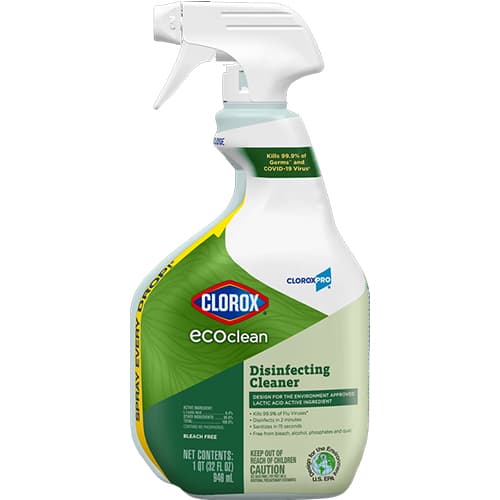
Over-concentrating sanitizer solutions wastes chemicals, can corrode equipment, and may leave unsafe residues on food surfaces. Proper dosing reduces both chemical waste and equipment wear. Peroxyacetic acid (PAA)-based sanitizers are considered more environmentally friendly than hypochlorites — they break down into acetic acid, oxygen, and water. EPA-registered eco-formulated options like the Clorox EcoClean Disinfecting Cleaner are available for operations looking to reduce environmental impact without sacrificing efficacy.
Browse cleaning agents and kitchen and food prep essentials for supplies that support a complete sanitizing workflow.
Common Uses
Usage in Context: Sanitizing solutions are used throughout every shift in a commercial kitchen — applied via sanitizer buckets with wiping cloths at prep stations, spray bottles for surface wipe-downs, and the third compartment of a three-compartment sink for manual warewashing of smallware and equipment. Kitchen managers and line cooks are responsible for maintaining active sanitizing solutions at each station, verifying concentration with test strips, and replacing solutions when they become cloudy or test out of range. Health inspectors routinely check that sanitizer buckets and spray bottles are properly labeled, correctly concentrated, and stored away from food. The practice is a core component of ServSafe training and any HACCP-compliant food safety plan.